( Compliance hub · Regulation (EU) 2024/1781 (ESPR) )
Unsold stock and the EU rules
We have spoken to a lot of brands that are not certain where they stand: whether the ban reaches them yet, and what has to be published once it does. So we wrote down what we know, with the passages that carry the weight quoted in full and the places where the law still says nothing marked as open. Every instrument is listed at the end, so any of it can be checked against the source rather than against us.
The position is stated as at 12 August 2026. It describes the law and is not legal advice.

For compliance and operations teams
What we know about the destruction ban
The position is stated as at 12 August 2026. It describes the law and is not legal advice.
The six parts
- 01Does the ban apply to us?
- 02What can we do with unsold stock?
- 03When is destruction allowed?
- 04What must we report and retain?
- 05The timeline to 2030
- 06What nobody knows yet
The dates that are fixed
Source for 2024 figure: EEA Briefing no. 01/2024
- 4 March 2024EEA Briefing no. 01/2024: 4–9% of textile products destroyed before use.
- 19 July 2026Ban applies to large companies.
- 19 July 2030Ban applies to medium-sized companies.
( The paper, in six parts )
What we know
For compliance and operations teams. Each part answers one question, and the full reasoning and references are in the paper.
01. Does the ban apply to us?
Large companies since 19 July 2026, medium-sized companies from 19 July 2030. Micro and small companies are outside it for now. The size test counts your whole group, not only the trading entity.
Related insightThe size test counts your whole group02. What can we do with unsold stock?
The regulation counts recycling and energy recovery as destruction. Sending a garment for repair, refurbishment or resale is not.
Related insightWhy good stock fails its second sale03. When is destruction allowed?
Ten grounds permit a large fashion brand to destroy the unsold products listed in Annex VII, set out in Commission Delegated Regulation (EU) 2026/296. Each is a claim the brand has to be able to evidence.
Related insightThe evidence file04. What must we report and retain?
Article 24 requires annual public disclosure of unsold consumer products discarded, and it is not limited to Annex VII. Derogation records are kept for five years, in electronic form.
Related insightTwo lists, two duties05. The timeline to 2030
19 July 2026: the ban applies to large companies. Their first annual Article 24 disclosure covers financial year 2025; the regulation sets no date for publishing it. 2 March 2027: the standard disclosure format applies, from financial year 2028. 19 July 2030: medium-sized companies.
Related insightEight things the unsold stock rules do not settle06. What nobody knows yet
The places where the law still says nothing are marked as open, and we say how we are reading them until they are settled.
Related insightEight things the unsold stock rules do not settle
( Market by market )
Named rules, named authorities
The destruction ban is EU law, but enforcement and related national rules sit with each member state. A brand operating in four or five EU jurisdictions runs four or five national regimes alongside the EU-wide Article 24 disclosure.
| Market | Instrument | Status | Authority |
|---|---|---|---|
| EU-wide | Regulation (EU) 2024/1781 (ESPR): Article 25 destruction ban for products in Annex VII, including apparel and footwear; Article 24 annual disclosure. Delegated Regulation (EU) 2026/296 sets ten derogations; Implementing Regulation (EU) 2026/2 sets the disclosure format. | Large companies: ban since 19 July 2026; first annual disclosure covers financial year 2025, with no fixed publication date; standard format from 2 March 2027, first for financial year 2028. Medium-sized: 19 July 2030. | National competent authorities in each member state, with records provided within 30 days of a request |
| Netherlands | ESPR, plus Besluit UPV Textiel, the national extended producer responsibility scheme for textiles | Producers register with Rijkswaterstaat and file an annual report before 1 August | Rijkswaterstaat (register and reports); ILT, Inspectie Leefomgeving en Transport (enforcement) |
| Spain | ESPR, plus Ley 7/2022 on waste, whose Article 18.2 bans destroying or landfilling unsold non-perishable goods, textiles included | National ban in force since 2022. A royal decree on producer responsibility for textiles and footwear is in draft, notified to the European Commission on 27 May 2026 | The autonomous communities inspect and sanction under Ley 7/2022; MITECO sets national rules |
| United Kingdom | Great Britain is outside the ESPR. Northern Ireland is covered through the Windsor Framework | Northern Ireland: ban since 19 July 2026 for large companies (British Retail Consortium guidance, 2026). A UK brand selling into the EU is bound there like any other | Northern Ireland: enforcing authority not yet named (British Retail Consortium, 2026) |
( Where Opera fits )
The recovery record is part of your evidence file.
For the damage and defect grounds, Article 3 of the delegated regulation expects evidence of quality assessment procedures, including visual inspection and sorting that prioritises restocking and repairs. Every item Opera handles is inspected and classified before any disposition is decided, and that record is written down garment by garment.
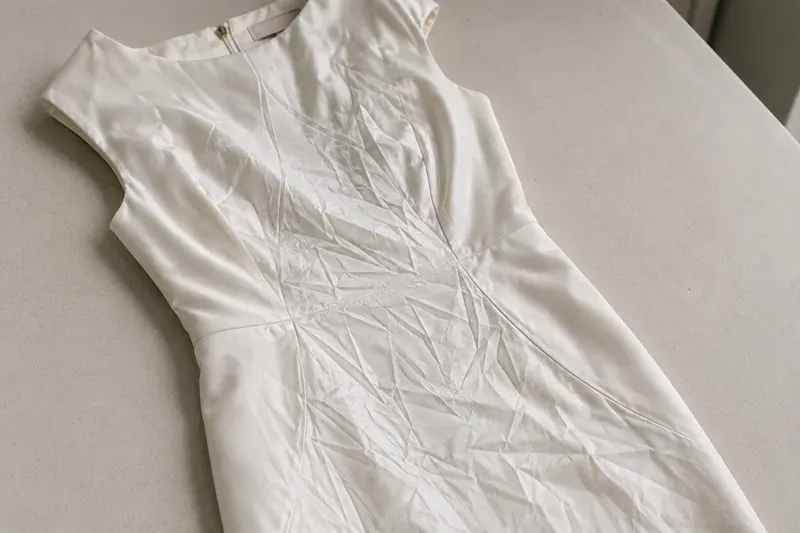
Occasion dress, satin
Returned after purchase · Madrid
- 01ReceivedWeekly pickup from your central point
- 02GradedSash detached at side seam · Grade C, repair
- 03Wet cleanedProfessional wet clean, satin programme
- 04RepairedSash re-attached, seam matched
- 05Quality checkPassed against your brand threshold
- 06RedeliveredSpanish e-commerce stock
( Compliance series )
Read the series
The size test counts your whole group
When a mid-market fashion brand is already covered.
Two lists, two duties
Which products the destruction ban reaches and which only have to be disclosed.
The evidence file
What a lawful destruction has to be able to show.
Who gets looked at, and what happens next
Verification and penalties under the ESPR.
Eight things the unsold stock rules do not settle
And the dates that are fixed.
Why good stock fails its second sale
What stops a returned garment selling again.
( Box Test )
Recovered value per garment, against your own SKUs.
Three-week Box Test. Decide from there.
01 · Today
Tell us about your stock on a short form.
02 · Collection
Opera collects a small batch of your own garments.
03 · Three weeks
You receive the Box Test report and decide from there.